

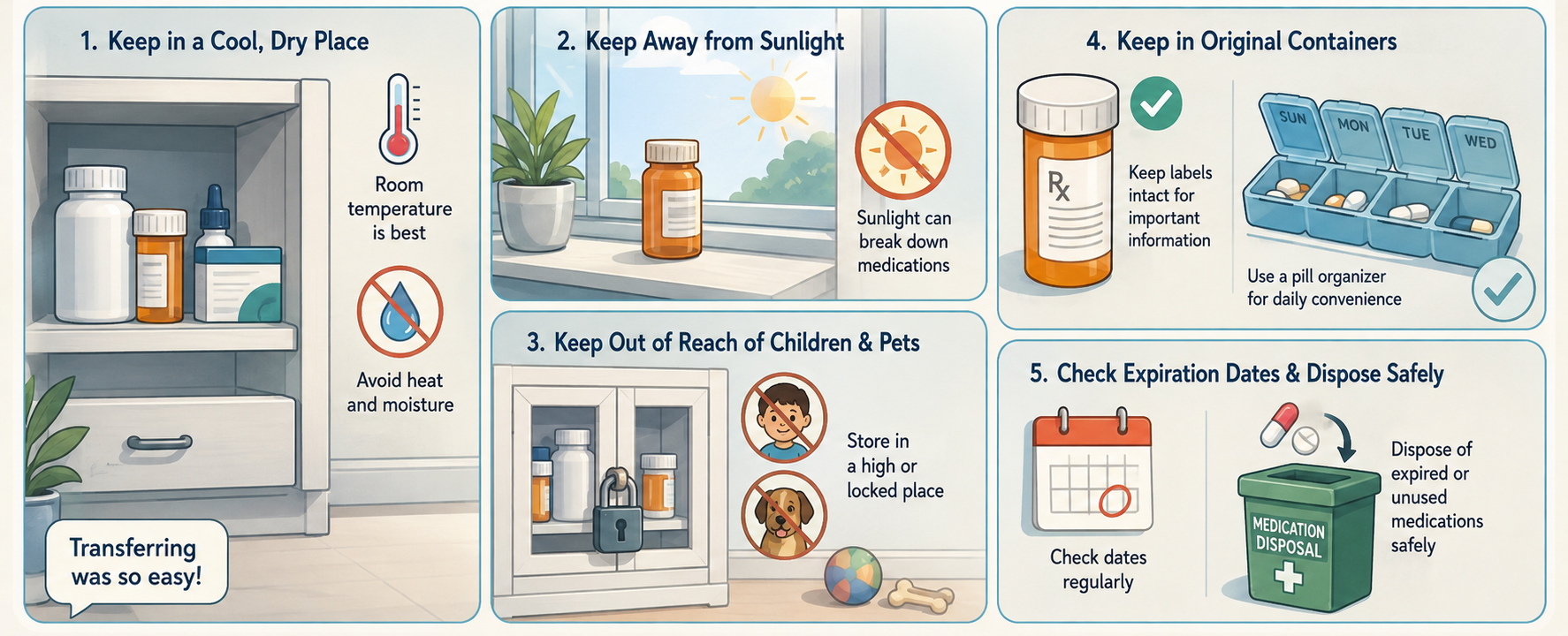
Most people keep their pills in the one place pharmacists tell you not to: the bathroom medicine cabinet. Between the steam from your shower and the swings in temperature, that cabinet is one of the worst places in your home for medication. And it’s just one of several everyday storage mistakes that can quietly reduce how well your medications work or turn an old bottle into a safety risk.
The good news? You don’t have to memorize any of this. Call Olympia Plaza Pharmacy at (323) 937-2590 any time you’re unsure about a medication, and we’ll walk you through it every step of the way.
Most medications are formulated to stay stable at room temperature, generally between 68–77°F. Heat and moisture speed up the chemical breakdown of active ingredients, which means:
That’s why bathrooms, kitchens near the stove, and cars (especially in San Diego’s warmer months) are all poor choices. A bedroom closet, a dresser drawer, or a kitchen cabinet away from the stove and sink is almost always a better option. Not sure if your specific prescription is heat-sensitive? Give us a call our pharmacists can tell you in seconds.
Many medications come in amber or opaque bottles for a reason — light, especially direct sunlight, can degrade certain compounds. If you’ve transferred pills into a clear pill organizer (which is great for adherence), just make sure the organizer itself is stored in a drawer or cabinet rather than left out on a sunny counter all week.
The original bottle isn’t just packaging, it’s information. It tells you (and anyone helping you in an emergency) the exact medication, dosage, prescribing doctor, fill date, and instructions. If you use a weekly pill organizer for convenience, that’s fine, but hang onto the original bottles too, and never mix different medications together in one unlabeled container.
Lost a label or can’t remember which prescription is which? We keep a full record of everything we’ve ever filled for you — just call the pharmacy and we’ll pull it up instantly.
Expired medications aren’t just less effective — some can actually become harmful as they break down. A few basics:
If you’ve got a shelf full of old bottles and don’t know what’s safe to toss, don’t guess — reach out to us and we’ll tell you exactly what to do with each one.
Some medications have storage needs that go beyond “cool, dry, dark”:
If you’re not sure how a specific medication should be stored, the safest move is to ask — every medication is a little different, and getting it wrong can mean paying for a prescription that no longer works the way it should. That’s exactly what we’re here for: call (323) 937-2590 and ask us anything, anytime.
Here’s the truth: you shouldn’t have to become an expert just to manage your own medicine cabinet, and you shouldn’t have to deal with the hassle of switching pharmacies either. That’s our job, not yours.
If you’re still using another pharmacy, transferring your prescriptions to us takes the whole process off your plate — no paperwork, no phone tag with your old pharmacy. We contact them, verify everything, and get your medications moved over correctly and safely. You don’t lift a finger.
Call us now at (323) 937-2590 — let us take it from here.